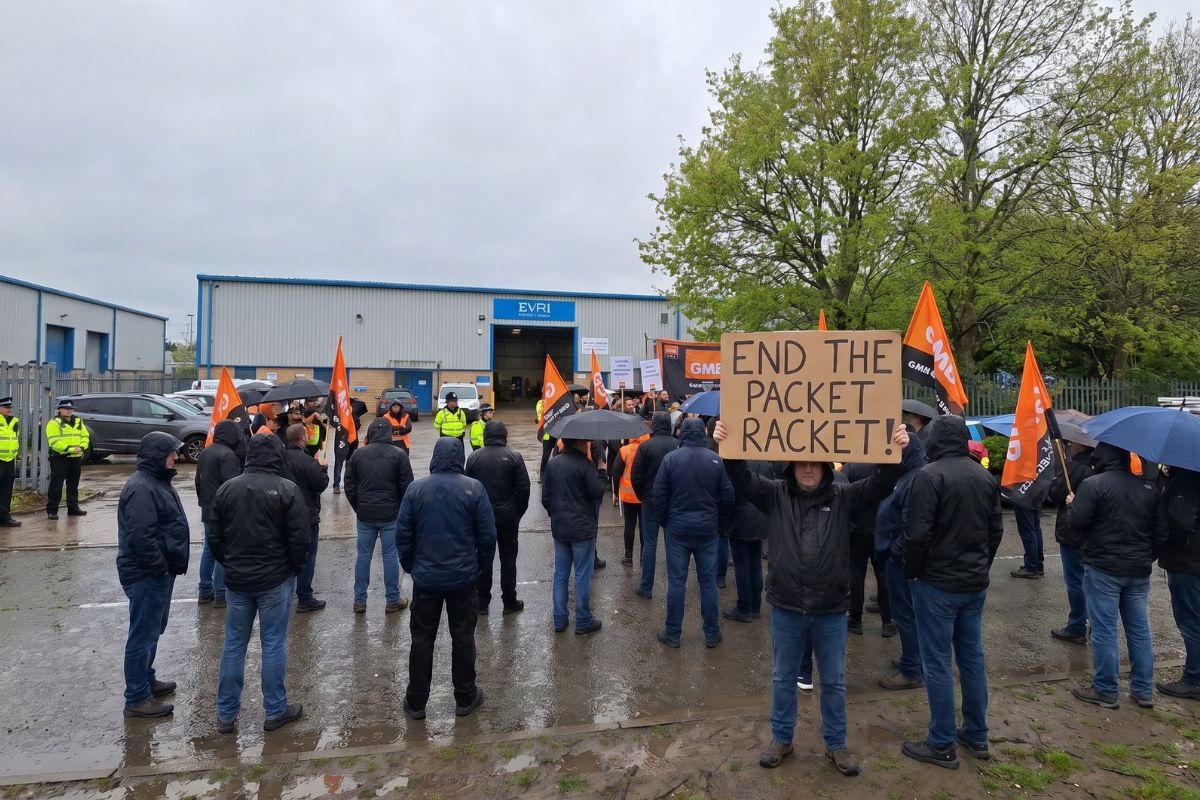
For the first time in its history, the GMB Union has told its Evri courier members to vote no on a pay deal.
That’s not a small thing. Unions exist to get deals over the line. When the National Committee actively recommends rejection, you know what’s landed on the table is bad.
And this one really is bad.
A Year Of Being Stood Up
Before getting into what’s actually in the offer, it’s worth understanding how long couriers have been waiting for it.
Pay talks were meant to happen in May or June 2025. They didn’t.
Evri pushed them back to November, then bumped them again because of “peak,” the run-up to Christmas when parcel volumes go through the roof.
A meeting set for 25 February 2026 was cancelled by Evri at the last minute. The reason given was “unforeseen circumstances.” Talks finally crawled into life on 4 March.
So by the time the company finally sat down at the table, a full year had passed since the GMB first put its claim in.
A year of cancellations, delays and “unforeseen circumstances.” And what couriers have ended up with reads as if the union and the company never spoke at all.
What The Union Actually Asked For
Back in April 2025 the GMB submitted a full claim covering the things couriers have been complaining about for years.
A pay rise. A single flat rate per parcel so the company couldn’t keep playing games with banding. Mileage in line with the taxman’s 45p figure. Faster pay corrections. Earlier depot opening times. More holiday for long service. Paid time off for MOTs and breakdowns.
There were specifics on every sore point. Small packets bumped up to 85% of the personal rate. A 15% rise on standard packets. Higher Service Payments raised to £2.50 per element. Admin payments doubled. A guaranteed minimum payment for misbanded parcels raised from 2 a day to 10.
You don’t need to understand every line. You just need to know this was a serious, detailed claim about real problems.
What Evri Came Back With
Almost none of it.
No flat rate. No 15% rise. No mileage uplift. No paid MOT time. Return-to-depot pay frozen at £6. Expenses to be “discussed later.” Claims targets to be “discussed later.” The 2025 pay claim, in the GMB’s own words, has not been delivered.
What Evri offered instead is a one-off cheque averaging £450 for most couriers, and a brand new pay metric that nobody outside the company can see, called the Equivalent Hourly Rate.
The Mythical “Equivalent Hourly Rate”
This is the part that should worry every courier.
Evri now wants to sort everyone into bands based on what it calls your Equivalent Hourly Rate, somewhere between £14 and £24 an hour. The figure seems to come out of the optimiser inside the delivery app, but Evri won’t actually spell out how it’s worked out.
Here’s how the bands work in plain English.
If you’re below £14 an hour (£14.80 in London), you’ll get a back-pay top-up covering three months. No lump sum on top.
If you’re above £24 an hour, no lump sum either, and Evri reserves the right to “individually negotiate” your rate. Translation: a pay cut conversation. You can have Union representation during these talks, but it’s unlikely to help.
If you’re between £14 and £23.99, you get the £450 average one-off payment, and you keep rate protection. But only until 12 May 2026. After that, it’s gone unless the GMB asks for an extension and Evri agrees to grant one.
So here’s the trap. Have one good day. Smash through your round. Push your hourly figure over £24 on Evri’s invisible calculation. Now you’re in the “let’s negotiate” bracket, and the rate protection that’s kept your pay stable for years has just evaporated.
This matters because GMB members are currently the only group in the entire company who haven’t been hit by the wave of rate cuts rolling through Evri in 2026.
Voting yes on this deal hands the company the keys to take that protection away.
The Packet Racket Gets Swept Under The Rug
The biggest fight of the last 18 months has been over what couriers call the “packet racket.”
In January 2025 Evri unilaterally introduced a new “small packets” category and rolled it out to SE+ couriers by March. It did this without union sign-off. Couriers say something like 20 to 30% of their daily parcels now magically fall into this lower-paying band.
People have reported flatpack furniture, radiators and clearly large items being labelled as small packets, with payments dropping as low as 35p a delivery.
Evri’s line is that 99.2% of parcels are correctly banded. Anyone who’s actually done a round will tell you that’s nonsense.
The other open dispute is misbanding more generally. Parcels going through at the wrong size, the wrong rate, and couriers having to chase the difference parcel by parcel.
Both of these arguments are formally classed as “Failures to Agree.” That’s the union term for an unresolved dispute. They’re the leverage the GMB has been using to push Evri to fix the problem.
Now read this carefully. If members vote yes on this deal, both Failures to Agree are considered closed. Resolved. Done.
For £450.
The GMB warns that accepting the offer could leave the union with no future Failures to Agree on the books at all. In other words, the lever it’s been using to force Evri to the table would be gone.
Worse, a high-volume courier who has spent the last year delivering thousands of small packets has lost a serious amount of money. Not £450. Thousands.
The one-off payment doesn’t even pretend to cover what’s actually been lost.
The Quiet Gutting Of Postables And HSP
There are two more changes buried in the offer that should set off alarms.
The first is the 5% postable uplift. Postables are the smallest items, things like letters and very flat packets. Couriers got a small extra uplift on those. Evri wants to scrap that uplift and “roll it into” the personal rate.
The headline rate for postables drops from 65% to 60% of the standard rate. The company says no one will be worse off, due to, you guessed it, “increased parcel volumes.”
The second is the Higher Service Payment.
This is the daily bonus, usually £3 to £4, that couriers get for hitting service standards: delivering on time, scanning every parcel correctly, taking the right photo evidence, keeping customer complaints low.
Evri wants to roll that into the personal rate too. The GMB opposed it.
Now here’s why this matters. Both of those payments are being absorbed into the personal rate. And the personal rate is only protected until 12 May 2026 for the vast majority of couriers, unless the GMB gets an extension.
So the bonus disappears into the headline rate, and then the headline rate becomes vulnerable to cuts. It’s a textbook bait and switch.
Evri has already done exactly this to its non-GMB couriers. The pattern is well established.
The 2024 Agreement Has Just Been Ignored
Under the Heads of Agreement signed in 2024, any new pay model was supposed to be properly agreed, fully understood, and signed off by all sides before it was rolled out.
National reps only met to start discussing the new pay model on 21 and 22 April 2026. The GMB describes that work as still in progress.
And yet here we are with the Equivalent Hourly Rate already baked into the 2025 deal, as if the agreement never existed.
Why Even Offer A Pay Deal This Bad?
That’s the question hanging over all of this.
Evri has just had its best year on record. For the full year to March 2025, the company posted adjusted EBITDA of £341 million and delivered 807 million parcels, an 11% volume increase on the year before.
Then the half-year results, covering the 26 weeks to 30 August 2025, took it up another notch. Parcel volumes rose by 47 million year-on-year to reach 425 million, a 12% increase. Adjusted EBITDA climbed 22% to £209 million. Revenue for the period also rose 12% to £973 million.
In other words, the company is now banking £209 million of profit in six months, when not long ago it was making £341 million across an entire year. Volumes are going one way. Wages are going another.
The argument Evri keeps trotting out, that rising parcel volumes offset any rate cuts, simply hasn’t held up.
Couriers have spent the last year delivering far more parcels for roughly the same money. In some cases for less.
So why offer something so bad that no courier in their right mind should accept it?
The cynical answer is that the structure of the deal helps Evri even if it gets rejected.
It floats the Equivalent Hourly Rate idea publicly. It tests how far the company can push.
And if it somehow passes, it closes both open disputes and clears the runway to take rate protection away from the last group in the company that still has it.
Where This Leaves Couriers
The GMB National Committee’s position is short and unusually blunt. Vote no.
The negatives stack up fast.
The 5% postable uplift gone. The Higher Service Payment gone. A new pay metric imposed without any agreed model behind it. Two huge active disputes “resolved” by ballot without actually being resolved. The 2025 pay claim not delivered.
For any courier earning above £14 an hour on Evri’s own invisible calculation, voting yes means accepting that rate protection potentially ends on 12 May 2026.
It means accepting that the bonuses now bundled into your personal rate can be quietly stripped away later.
It means accepting that the biggest collective fights of the last year are officially over for the price of a one-off £450 payment.
It’s hard to think of a deal that more obviously deserves to be sent back.
If members hold the line, Evri will have to come back with something that actually resembles the claim that was put on the table over a year ago.
If they fold and accept the deal, the protections that have kept SE+ GMB couriers off the rate-cut conveyor belt may not survive the summer.
The GMB’s own line says it best. “This is a full and final offer. The offer does not reflect our claim. It does not respect previous agreements. Members’ voices matter. Together, we must demand better.”
After a year of delays, cancelled meetings and “unforeseen circumstances,” the only sensible answer to what Evri has finally put on the table is no.