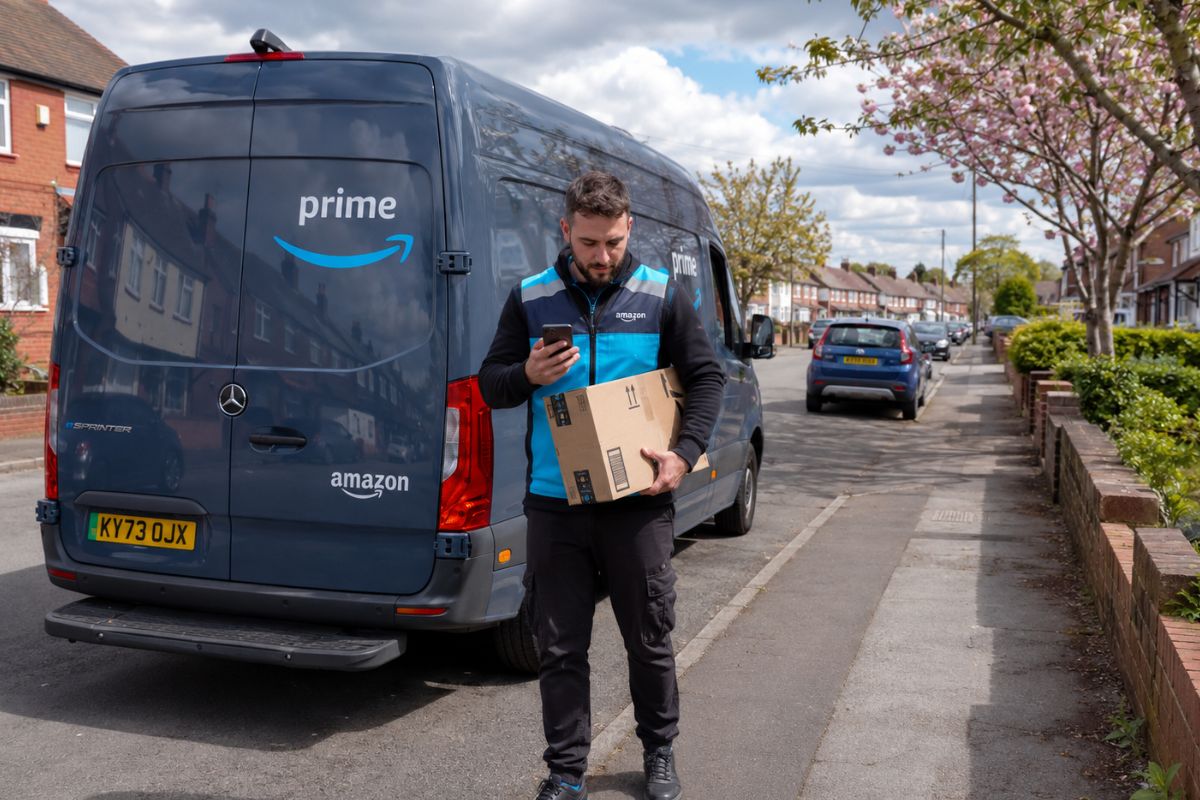
If you’re one of the thousands of drivers who pull up to an Amazon depot every morning, sign into an Amazon app, wear Amazon-branded kit and deliver Amazon parcels to Amazon customers, the law firm Hugh James has a question for you.
Have you actually been paid like an Amazon worker?
The firm has just launched a group action against Amazon on behalf of UK delivery drivers, targeting two things specifically: unpaid holiday pay, and a potential top-up for anyone who’s effectively been earning below the national minimum wage once the full picture of their hours and costs is taken into account.
Any claim will be pursued through the Employment Tribunal, which is the court set up to deal with exactly this kind of employment dispute.
What’s Actually Being Claimed
The case rests on a legal argument that will sound very familiar to anyone who followed the Uber drivers case a few years back.
Amazon delivery drivers in the UK don’t technically work for Amazon. They work for a DSP – a Delivery Service Partner.
These are the third-party companies that Amazon contracts to actually put vans on the road.
Drivers swap between DSPs fairly often, but the job itself barely changes. Same routes. Same depots. Same vans in many cases. Same app. Same company logo on the side of the vehicle.
Hugh James’ argument, stripped back to plain English, is that regardless of which DSP a driver’s contract has technically been with at any given moment, they’ve effectively been working for Amazon the whole time.
If that argument lands, it opens the door to claims for holiday pay that drivers say they haven’t properly received, and to national minimum wage top-ups where total earnings, once you factor in actual hours and deductions, fall below the legal floor.
Neither of those are small items. Holiday pay alone, stretched across a full working history, can add up to thousands of pounds per driver.
Who Can Join The Group Action Against Amazon
This is the bit the drivers reading will care about most. The eligibility rules are tight, and they’re tight for a specific reason.
To be considered for the group action, you need to meet two conditions.
You must currently be an active delivery driver for Amazon. And you must have been with your current DSP for at least six months.
The reason for the strict cut-off is the Employment Tribunal deadline.
In tribunal cases, the clock runs out three months minus one day from the date of the issue or from your last day of work.
That’s an unusually short window in the legal world, and it means anyone who has already stopped driving for Amazon is very likely to be time-barred by now.
Hugh James is clear on this point: if you’ve already left the role, they can’t help, and they’re directing former drivers to seek independent legal advice elsewhere.
There’s also a continuity requirement.
To run the argument that drivers have effectively been Amazon workers throughout their career, claimants need to have worked continuously as a delivery driver, even if they’ve moved between DSPs along the way.
A gap in the timeline weakens the argument.
How It Works If You Sign Up
The process starts with a questionnaire on the Hugh James website.
If the answers suggest you’re eligible, you’ll be asked to upload evidence of your work as a driver – things like invoices, work contracts, and vehicle hire agreements.
Hugh James then runs a risk assessment on the information before deciding whether to take the claim on.
Only when a retainer is actually signed are you formally a client and is a claim being pursued on your behalf.
Registering interest on the questionnaire is not the same as having a live legal claim.
Once a retainer is in place, the first stop is ACAS, the independent conciliation service. ACAS gives both sides up to six weeks to try and reach a settlement before anything is filed.
It’s optional, and if nothing comes of it, ACAS issues a reference number that allows the claim to be lodged with the Tribunal.
Amazon would then have 28 days to respond, though it can request extensions.
Because this is a group action, there’ll be a preliminary case management hearing to sort out the shape of the case before anything goes to a full hearing.
Settlement can be offered by Amazon at any stage.
Hugh James is running the case on a no win, no fee basis, specifically a Damage-Based Agreement.
In practice that means claimants don’t pay anything up front. If the case wins, the firm’s fee comes out of the compensation awarded, up to an agreed percentage.
If it loses, there’s no bill, provided the claimant has been honest and has followed instructions.
The one big caveat is that drivers who provide fabricated information once a retainer is signed can be hit with a costs order by the Tribunal, making them liable for Amazon’s costs.
Therefore, honesty throughout is non-negotiable.
Why This Matters Beyond The Drivers Themselves
Hugh James is not a small operator picking a fight it can’t back up.
The firm bills itself as the most experienced group action firm in the UK and has led or co-led cases that have been sizeable by any measure, including the Port Talbot Steelworks Group Litigation, the British Coal Coke Oven Workers Litigation, and the British Steel Coke Oven Workers Litigation.
When a firm with that track record decides to take on Amazon in the Employment Tribunal, it’s a signal that they believe the legal argument holds water.
It’s also the latest in a clear pattern. Uber drivers. Deliveroo riders. Gig-economy couriers across the board. Court after court has been asked to look behind the contracts and the corporate structures and work out who really employs the person at the wheel.
The courts have, in several of those cases, sided with the drivers.
Amazon has long maintained that its delivery drivers work for their DSPs, not for Amazon. That’s the position Hugh James is now directly challenging.
What To Do If You Think You’re Eligible
If you’re currently driving for Amazon, you’ve been with your current DSP for six months or more, and you’ve worked continuously as a delivery driver across any previous DSPs, the next step is straightforward.
Head to the Hugh James website, find the Amazon delivery drivers claim page, and complete the questionnaire. Have your paperwork to hand — invoices, contracts, vehicle hire agreements, anything that evidences the work.
If you’ve already left the role, the three-months-less-a-day Tribunal deadline means this particular group action almost certainly isn’t open to you, but you still have options.
Independent legal advice, as Hugh James themselves suggest, is the right starting point.
For everyone else watching from the sidelines, this is one worth following.
If the argument that Amazon drivers have really been Amazon workers all along succeeds at Tribunal, the consequences won’t stop at holiday pay cheques.
They’ll ripple through the entire model the big logistics platforms have built in the UK, and they’ll raise very awkward questions for every delivery company that’s spent the last decade insisting the person delivering their parcels isn’t technically theirs.