Evri couriers have been receiving emails over the past couple of weeks telling them they have been overpaid holiday pay and that the company will be clawing it back in one lump sum on their next invoice.
For some, the email is a fair correction. They were paid for days they did not book and they accept the money needs to come back.
For others, the email is the start of a potential financial nightmare.
The numbers do not match what they were paid. The amounts being reclaimed are higher than the amounts that landed in their accounts. And the recovery is happening in a single hit, with no option to spread it out.
Some couriers are now staring down deductions of £600, £1,200, even £1,500 on their next invoice.
One courier told us exactly what that means in practice.
“They will swipe this £600 in one go, meaning I will be visiting a food bank next month just to survive.”
That is not an exaggeration.
That is the reality of self-employment when a high three or four-figure deduction lands on a single invoice with no warning and no negotiation.
What Evri Is Telling Couriers
The emails landing in courier inboxes follow the same template, with the figures and the number of days varying case by case.
One example reads as follows.
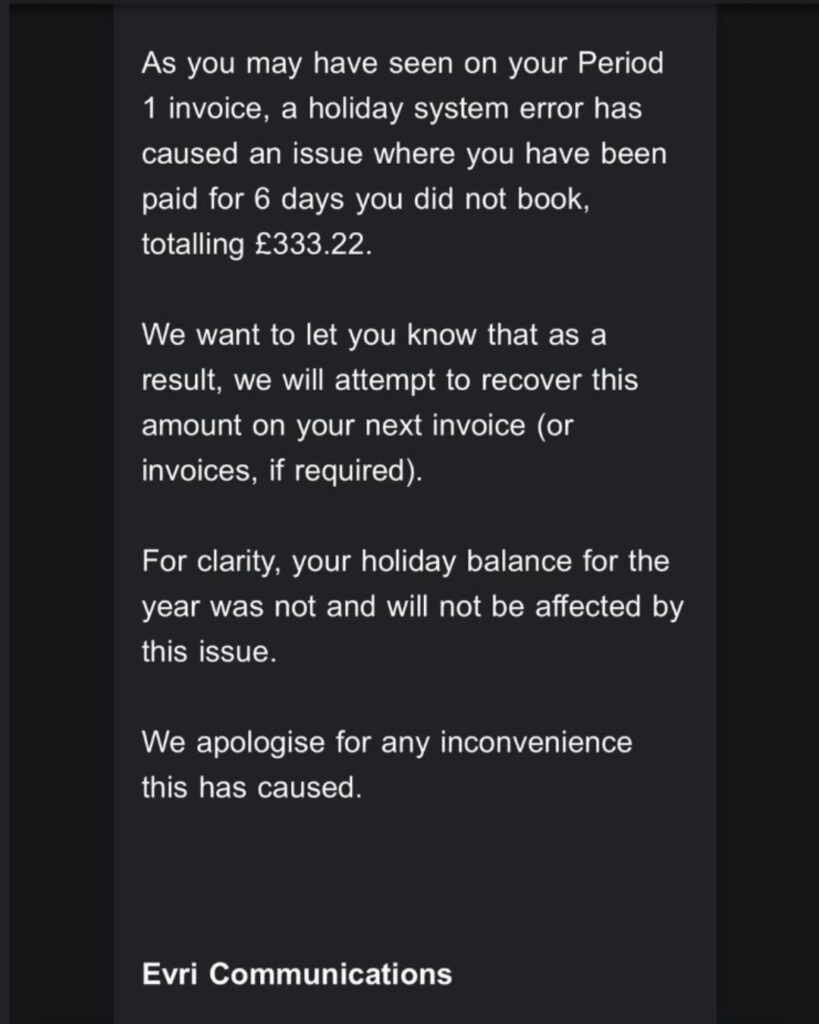
“As you may have seen on your Period 1 invoice, a holiday system error has caused an issue where you have been paid for 6 days you did not book, totalling £333.22.”
“We want to let you know that as a result, we will attempt to recover this amount on your next invoice (or invoices, if required).”
“For clarity, your holiday balance for the year was not and will not be affected by this issue.”
“We apologise for any inconvenience this has caused.”
On the surface, that reads like a routine correction.
The problem is that the figures Evri is quoting in these emails are not matching, in many cases, the figures couriers actually received.
The Numbers Are Not Adding Up
One courier shared their email publicly this week. Evri said they had been overpaid £333.22 across six days of holiday they did not book.
The actual amount paid into their account was £239.00.
That leaves the courier almost £100 out of pocket if Evri takes back the full £333.22 it says it is owed.
Another courier got in touch to say they were owed £800 in holiday pay. They were paid £1,000. Evri now wants £1,200 back.
A third case is even worse.
A self-employed plus courier with five years on the road, running two rounds, six days a week, took 19 days of holiday in February. They worked some of those days because of time pressures. When the holiday pay landed, it was over £1,000 short.
They raised it through the CCA app. The enquiries did not go through. They spoke to their CDM. They spoke to their GMB rep. They emailed delivery support. After multiple replies, no resolution.
Last week, the same courier received an email from Evri saying the company believed they had been overpaid by around £1,500 and would be reclaiming it on the next invoice.
So the position is this.
Underpaid by around £1,000. Being asked to repay around £1,500.
That is a swing of £2,500 against a single courier, with screenshots, evidence and a paper trail, and nothing has been resolved.
Why This Looks Like a System Mess, Not a Driver Error
A working theory is doing the rounds among couriers, and it makes sense of a chunk of these cases.
Holiday pay due in Period 12 of the previous financial year was not processed correctly. It was paid in Period 1 of the new financial year instead.
When that payment lands in the new year, Evri’s system sees a holiday payment with no corresponding booked holiday in the new year’s records. The system flags it as an overpayment. The automated email goes out.
That would explain why couriers who took legitimate holidays months ago are now being told they were paid for days they did not book.
It does not explain why the figures being reclaimed are higher than the figures actually paid.
It does not explain why couriers who were already underpaid are now being chased for sums that bear no relation to what hit their bank accounts.
The Lump Sum Problem
Even where the overpayment is genuine, the recovery method is brutal.
Evri is taking the money back in one go, on the next invoice.
For a self-employed courier living invoice to invoice, a £600 deduction in a single month is the difference between paying the bills and not paying the bills. A £1,200 or £1,500 deduction is catastrophic.
This is rent money. Mortgage money. Food money. Money for the kids’ school shoes. Money for the next tank of diesel that gets the courier back out on the round.
Pulling that out of a single invoice, with a few weeks of notice at best, is not a correction. It is a punishment for an error the courier did not make.
The Contract Clause Evri Should Be Reading
Upon joining, self-employed plus (SE+)(which is now called Evri Plus) couriers sign a contract. One clause in that contract is about to come under serious scrutiny.
Clause 3.6 states that courier pay must meet the National Living Wage after expenses are accounted for.
If Evri pulls £600, £1,200 or £1,500 out of a single invoice, the courier’s earnings for that period after fuel, insurance, vehicle costs and tax will not even come close to the National Living Wage in many cases.
That is a contractual breach written into the very document Evri asked couriers to sign.
Underpayments Take Months. Recoveries Take Days.
Here is the part that stings.
Couriers who are owed money by Evri are routinely waiting weeks or months to get it back. Some are having to issue letters before action just to get underpayments resolved.
When Evri thinks it is owed money, the recovery is instant. One invoice, one deduction, done.
A courier currently chasing £400 in underpayments from previous invoices is about to lose £600 from his next invoice without a word of negotiation.
The asymmetry is hard to miss, and is infuriating for those experiencing it.
This Is Sitting on Top of the Invoice Shortfall Issue
The holiday pay mess is landing at the same time as a separate and ongoing problem with Evri invoices.
Couriers going through their invoices line by line, multiplying parcels delivered by the rate for each banding, are finding the totals come in short.
A courier expecting £500 for 1,000 small packets at 50p is finding £480 on the invoice. Some couriers are £100+ short on a single month.
Others have gone back six months or more and found small discrepancies stacking up into serious money.
So the picture for a lot of couriers right now looks like this.
- The invoice is short to begin with.
- The holiday pay was either underpaid or paid in the wrong period.
- A clawback email has just landed for an amount that does not match what they received.
- The clawback is happening in one hit on the next invoice.
That is four separate financial pressures landing at once on people who have to cover their own fuel (which already way above normal prices at the moment), vehicle wear and tear, and insurance costs out of every payment they receive.
What Couriers Are Being Told to Do
The official route is to raise an enquiry through the CCA app.
The problem, as multiple couriers have pointed out, is that the enquiries are either not going through at all or are coming back with replies that do not address the issue.
GMB reps are aware. CDMs are aware. The central pay team has been informed.
But resolutions are not happening at the speed required to stop the lump sum deductions landing on the next invoice.
Where This Leaves Couriers
Evri’s holiday pay system has thrown out a wave of overpayment notices that, in a meaningful number of cases, do not match reality.
Some of those notices are for amounts higher than the courier actually received.
Some are landing on couriers who are already owed money the company has not paid back.
All of them are being recovered in one lump sum on the next invoice.
Self-employed couriers often do not have the financial flex to absorb a high three or low four-figure deduction on a single invoice. The contract they signed says they should not have to.
Evri has called this a “system error” and apologised for the inconvenience.
For the courier already working out which food bank he will be relying on next month, inconvenience is not the word.