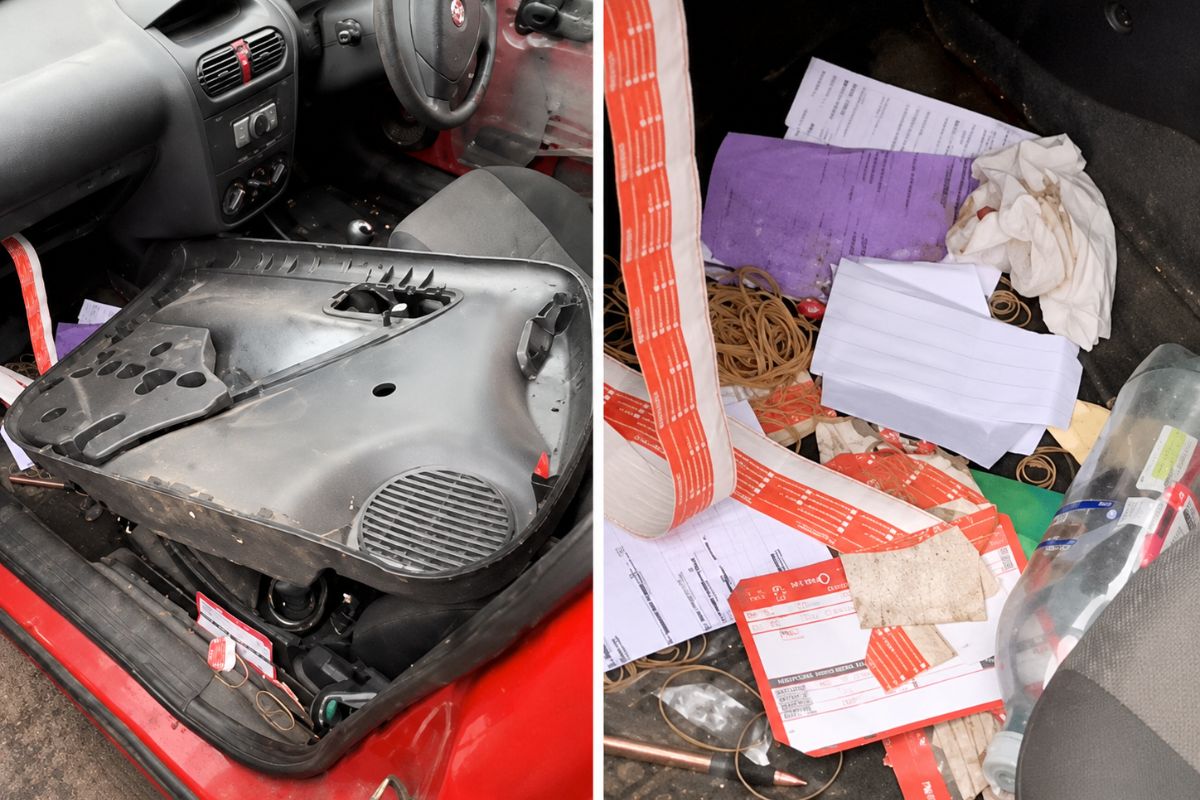
If a birthday card has turned up a week late, a hospital appointment letter has missed its date, or a council tax bill has landed on the mat at the same moment as the court summons for not paying it, the urge to shake a fist at Royal Mail is more than understandable.
The news of Ofcom fining Royal Mail another £21 million in October 2025 will have felt, on first read, like the regulator finally doing its job.
The problem is that three years of escalating Royal Mail fines have produced three years of worsening delivery performance.
That is the definition of a strategy that does not work, and once you understand how most of those late letters actually got into Royal Mail’s hands in the first place, the reason the fines are not working becomes pretty obvious.
Ofcom has been punishing Royal Mail for symptoms while leaving the cause completely untouched. The cause is sitting in a system most people have never heard of, which quietly governs 70% of all UK letter volume.
The Fine Pile That Has Not Changed a Thing
The October 2025 penalty was the third year in a row Ofcom had taken action over missed delivery targets.
The running total is now past £37 million across the three years, with the previous two fines coming in at £10.5 million in 2024 and £5.6 million in 2023.
The 2025 fine landed after Royal Mail managed only 77% on first-class delivery against a 93% target, and 92.5% on second-class against a 98.5% target.
Even a softened internal improvement plan, which aimed for 85% on first class and 97% on second class, had been missed comfortably.
The fine money does not go to Royal Mail’s delivery offices. It does not buy new vans or new posties, and it does not help the rural rounds that are quietly eating most of the cost of running the network. Ofcom fines go straight to HM Treasury and stay there.
Royal Mail reported its first annual profit in three years in late 2025 at around £12 million, which is barely a rounding error against the parent group’s losses totalling best part of £800 million across the previous two financial years.
Punishing a company in that much trouble with a fine does not look like enforcement. It looks like an accounting exercise that hands the Treasury a cheque and leaves the underlying delivery problems exactly where they were before.
Most of “Royal Mail’s” Letters Aren’t Really Royal Mail’s
Here is the bit most customers do not know, and it changes the whole story.
When that hospital letter, that council tax bill, that bank statement or that utility reminder drops onto the mat, the chances are it never started its journey at a Royal Mail sorting office at all.
It started at one of Royal Mail’s competitors.
The big institutions that send out the bulk of the country’s post, hospitals, councils, banks, energy companies, do not generally hand their mail to Royal Mail anymore.
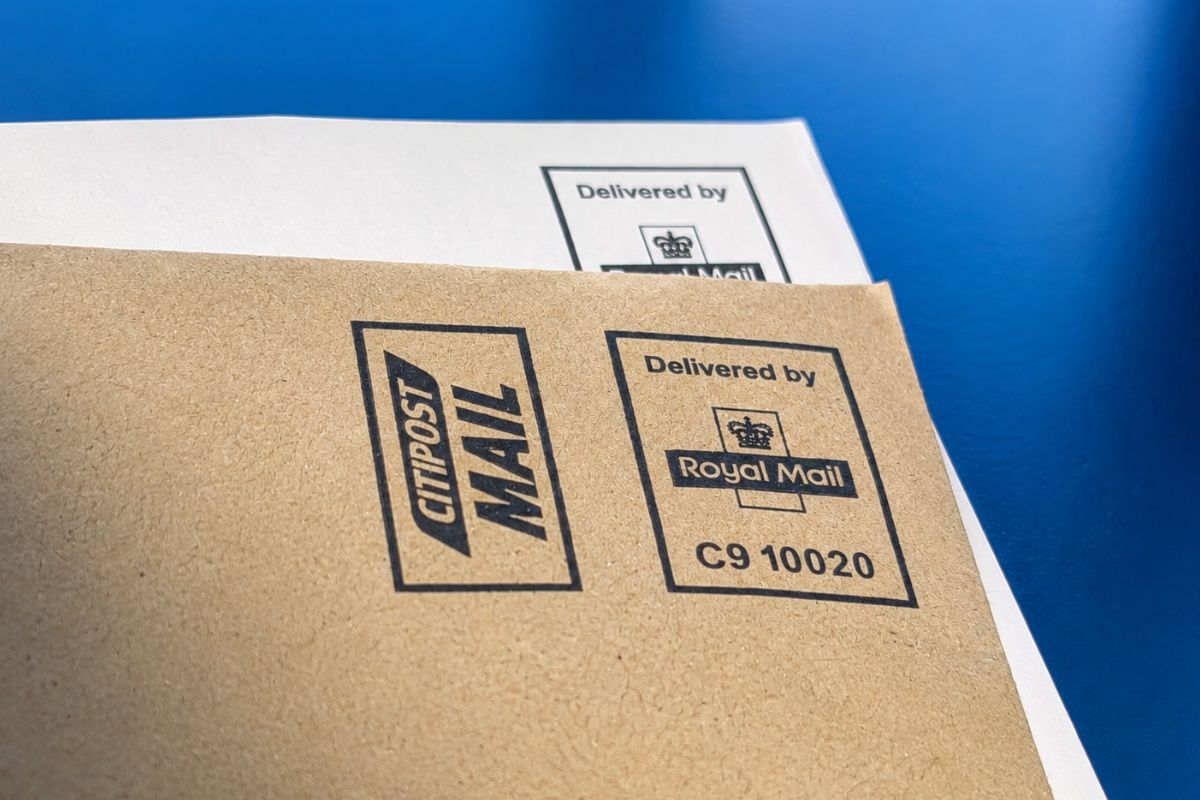
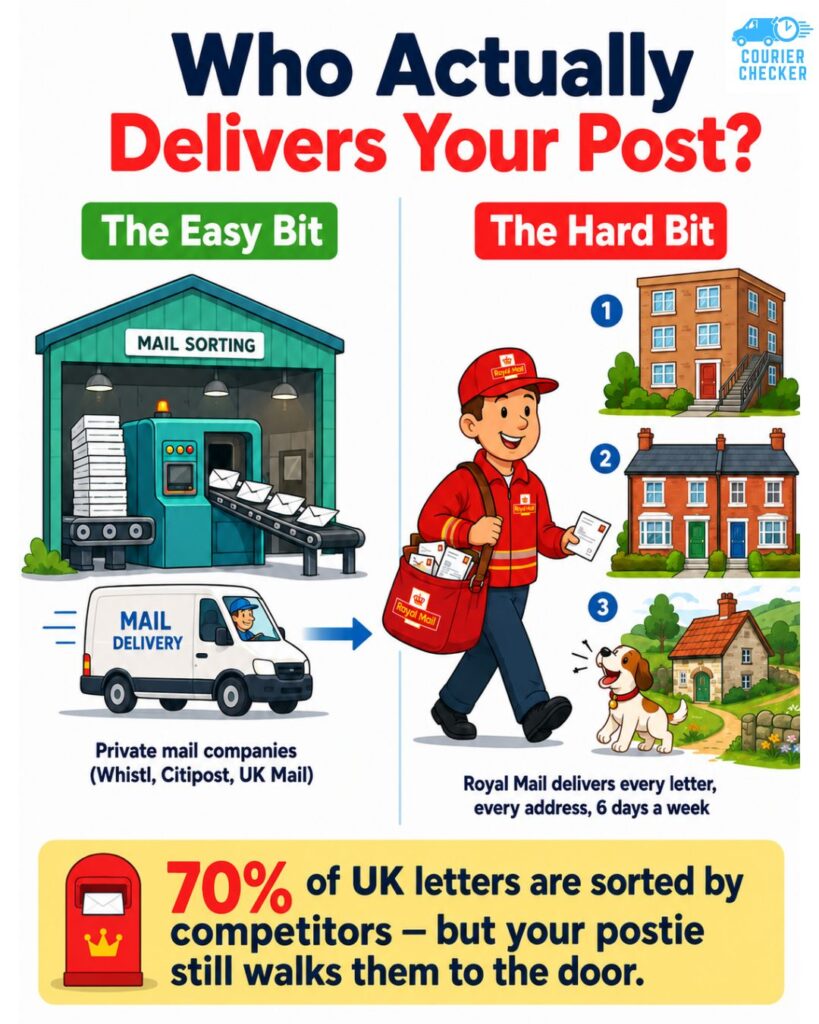
They hand it to private mail companies like Whistl, Citipost and UK Mail, who collect it in bulk, sort it in their own warehouses, and then bring it round to the back door of a Royal Mail sorting office for the last leg of the journey.
The postie walking up your street is doing that final leg. They are carrying a bag of letters, and most of those letters were sorted and delivered to Royal Mail by somebody else.
The proper name for this is the Downstream Access system, usually shortened to DSA.
Around 70% of all UK letter volume now goes through it, which works out at roughly 4.5 billion letters a year being carried the hardest part of the journey by Royal Mail on behalf of someone else.
The competitors keep a tidy chunk of the overall mail revenue for doing the front-end work.
So when a hospital appointment letter turns up late, the customer blames Royal Mail, Ofcom fines Royal Mail, and the company that the hospital actually paid to send the letter in the first place is nowhere in the conversation.
The Easy Bit and the Hard Bit
The split that matters here is not where the revenue goes, because Royal Mail does get paid an access fee for doing the final leg.
The split that matters is which bit of the work each side has actually signed up for.
The competitors are doing the easy bit.
Picking up huge sacks of identical letters from a bank or a council, running them through a sorting machine in a single warehouse, and dropping them in bulk at a Royal Mail centre. It is the bulk, urban-facing, machine-friendly part of the job.
Royal Mail is doing the hard bit.
Walking the letters to the door, up four flights of stairs to a flat with a broken buzzer, down a Cornish lane to a farmhouse, through a council estate where the dogs know the postie by name. It is the door-knocking, stair-climbing, country-lane part of the job, and it costs the most per letter because it cannot be automated.
In plain terms, your postie is subsidising a competing private business model.
Royal Mail still has to deliver six days a week to every address in the country whether the letters started in its system or not.
The competitors get to pick and choose where they want to operate. Nobody has seriously asked whether the price Royal Mail is allowed to charge for that final mile actually reflects what the final mile costs.
The Cherry-Picking Problem Ofcom Already Admitted To
Royal Mail’s own evidence to Parliament has been blunt on this for years.
The company has told MPs that this kind of competition has cut letter volumes by around 15% in the most profitable urban areas, while the obligation to keep delivering six days a week to the Highlands, the Cornish coast, and every rural postcode in between sits entirely on Royal Mail’s shoulders.
This is what people in the industry mean by cherry picking. The polite word for it is regulatory arbitrage, which is a fancy way of saying a private operator builds a business model entirely out of the bits of a network that are cheap to serve, and leaves Royal Mail to absorb the rest.
The really damning bit is that Ofcom itself admitted this was a problem back in 2013, and said giving Royal Mail flexibility to set zonal access prices, charging competitors more to use the hard routes than the easy ones, would help fix it.
When Royal Mail then tried to do exactly that, Whistl complained, and Ofcom suspended the change for up to two years.
That removed the single most obvious tool Royal Mail had to defend itself against the very problem the regulator had already identified.
Years later, the same regulator started fining Royal Mail for the symptoms of the financial squeeze it had refused to let the company address.
The public is currently paying for that decision in late letters and missed appointments.
What the Universal Service Actually Costs
The number that ought to be at the centre of this whole conversation is Ofcom’s own estimate of the net cost of providing the Universal Service Obligation, which the regulator has put at between £325 million and £675 million a year.
That works out at roughly £1 million to £2 million every single day.
That figure is not a Royal Mail lobbying number.
It is Ofcom’s own calculation of the gap between what Royal Mail makes carrying universal service mail and what it could have made running the network as a purely commercial parcels operation, without all the rural addresses tied to it.
The Postal Services Act 2011 says the universal service provider should be financially sustainable and able to earn a commercial rate of return.
Ofcom’s own benchmark for sustainability is a margin of 5% to 10%. Royal Mail’s letters business has averaged less than 1% since 2015/16.
The UK has also added something in the order of 4 million new addresses to the delivery network since the access mail system started.
In the same period, total letter volumes have collapsed from 20 billion a year two decades ago to about 6.7 billion now, with Royal Mail’s own forecasts pointing to roughly 4 billion within a few years.
A network that has to walk further, climb more stairs and knock on more doors every year while carrying fewer letters is a network that gets more expensive per delivery every single year.
A regulator that fines that network for getting slower without addressing why it is slowing down is not actually regulating it. It is just clipping it.
The 2025 Reforms Touched the Wrong Lever
Ofcom’s big move in July 2025 was to let Royal Mail change the shape of the service rather than the shape of the access market.
Standard DSA shifted from a two-day delivery window to three days, a new five-working-day Economy DSA tier came in, and a faster DSA Priority option was bolted on top.
These are useful operational savings.
Frontier Economics has estimated the reforms will deliver annual net savings of £250 million to £450 million if the new service model is rolled out properly, and they will buy Royal Mail some breathing room.
What they did not do, however, is touch the structural unfairness in DSA pricing.
The underlying economics of the network, the bit that makes cherry picking profitable for competitors and unprofitable for Royal Mail, has been left exactly where it was.
Even at the top end, £450 million a year does not cover the upper estimate of the universal service net cost.
Ofcom has used up the easy lever, the service-window one, without going near the harder political lever, the one that would ask private operators to contribute more fairly to the network they are using.
What Ofcom Could Actually Do Without Going Anywhere Near Parliament
A USO contribution levy is the cleanest fix on the table.
It would work the way the electricity grid does.
Every supplier using the wires pays toward the standing cost of keeping the network live, because the network has to exist for any of them to have a business at all.
A USO levy would apply the same logic to postal access operators, with contributions scaled to the volumes they hand over for final-mile delivery.
Zonal access pricing is the second one, and it is the one Ofcom already said would help back in 2013.
The access fee a competitor pays to have a letter delivered to a remote farm would reflect what delivering to a remote farm actually costs, instead of being averaged out across the entire UK so that urban routes effectively subsidise the rest.
Margin reform is the third, and it is the least dramatic but probably the most overdue.
It would give Royal Mail commercial freedom to set wholesale access rates based on its actual delivery costs in 2026, not on a framework built when the network looked nothing like it looks now.
None of those three changes need an Act of Parliament.
None of them remove competition from the postal market, and none of them undo the access regime that has brought genuine downward pressure on bulk-mail prices for big business mailers.
What they do is bring the rules of the game into line with the physics of the job, which is the bit Ofcom has consistently failed to address while keeping the fine book within easy reach.
Picking the Pockets of a Company That Cannot Afford the Fine
If the country wants a six-day, every-address, every-postcode postal service of the sort that has just about survived under the current Universal Service Obligation, the way to keep it alive is not to fine the provider until the wheels come off.
It is to make the access rules fair enough that the wheels stay on without subsidy from postal workers servicing longer rounds for less.
Ofcom fining Royal Mail another £21 million in 2025 took roughly twice the company’s annual profit out the door, sent it to the Treasury, and bought the public exactly nothing in improved delivery performance.
The access pricing structure, the cherry picking, and the rural-route economics were left untouched.
Ofcom already has the powers it needs.
A USO levy, zonal access pricing and margin reform are sitting on its own desk right now, none of which require legislation, and all of which would do more to protect the service than another headline-friendly Royal Mail fine.
If the next move out of Ofcom is another investigation followed by another penalty, rather than a serious look at the rules the network has been operating under since the original Whistl complaint in 2013, the only safe prediction is that this article will be just as relevant the next time Royal Mail misses its delivery targets.
Which, on current form, is likely to be about six months from now.