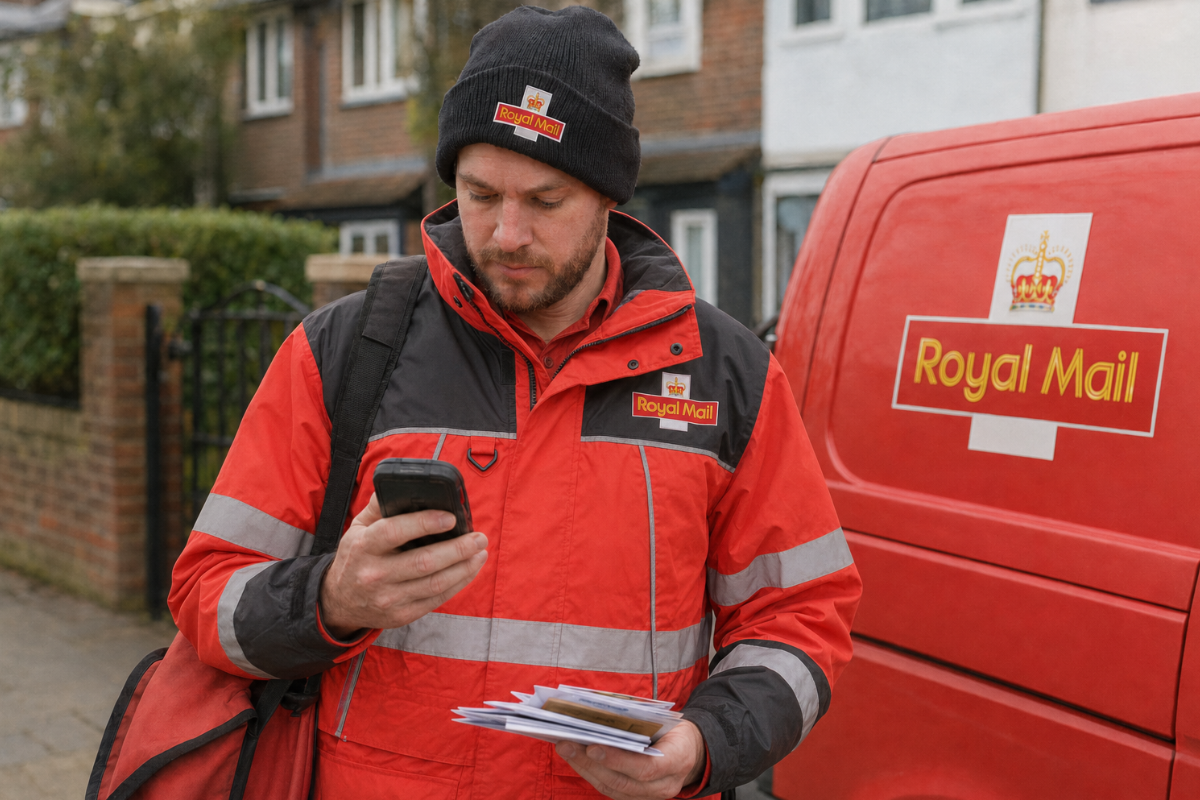
Every postie in the UK carries a Personal Digital Assistant on every round.
Managers use the data from those devices to question performance, pull up loop times, and press posties on why routes took longer than the model said they should.
What those same managers may not have fully considered is that the PDA is recording something else at the same time.
It is recording, in forensic detail, whether the mail is actually being delivered.
What Royal Mail Has Been Telling MPs
In recent correspondence with MPs, Royal Mail set out its position on so-called “contingency guidance”, the internal policy that allows delivery offices to prioritise some products over others when they are short-staffed or overwhelmed.
The letter states: “we estimate we apply the guidance to less than 10% of addresses a day throughout the year, where there is mail to deliver.”
Translation: on any given day, fewer than one in ten UK addresses are affected by a delivery office choosing to push parcels and tracked items out while leaving standard mail behind.
Anyone who has set foot on a delivery office floor in the last two years will recognise that figure for what it is.
The standing instruction in offices up and down the country is some version of the same sentence: do your specials, get your tracked done, and if there is time after that, do the mail.
Often, there is not time. And the decent chunks of the mail comes back.
What the PDA Actually Records
The PDA is not just a scanner. It is a tracking device, a timing device, and a performance log rolled into one.
Royal Mail’s internal systems cross-reference its output against routing software (GeoRoute) that calculates how long any given loop should take if walked and delivered in full.
That modelled time is called the Outdoor Model. The time the PDA records on the street is called the Outdoor Actuals.
These are the numbers managers pull out in one-to-ones to ask posties why a loop took 30 minutes longer than it “should” have.
What those same numbers can also do is prove when a loop was completed in a fraction of the time it would take to walk it properly.
The Three Things the Data Would Show
1. The Digital Breadcrumb Trail
The PDA drops a GPS ping at regular intervals, recording the postie’s exact location throughout the round.
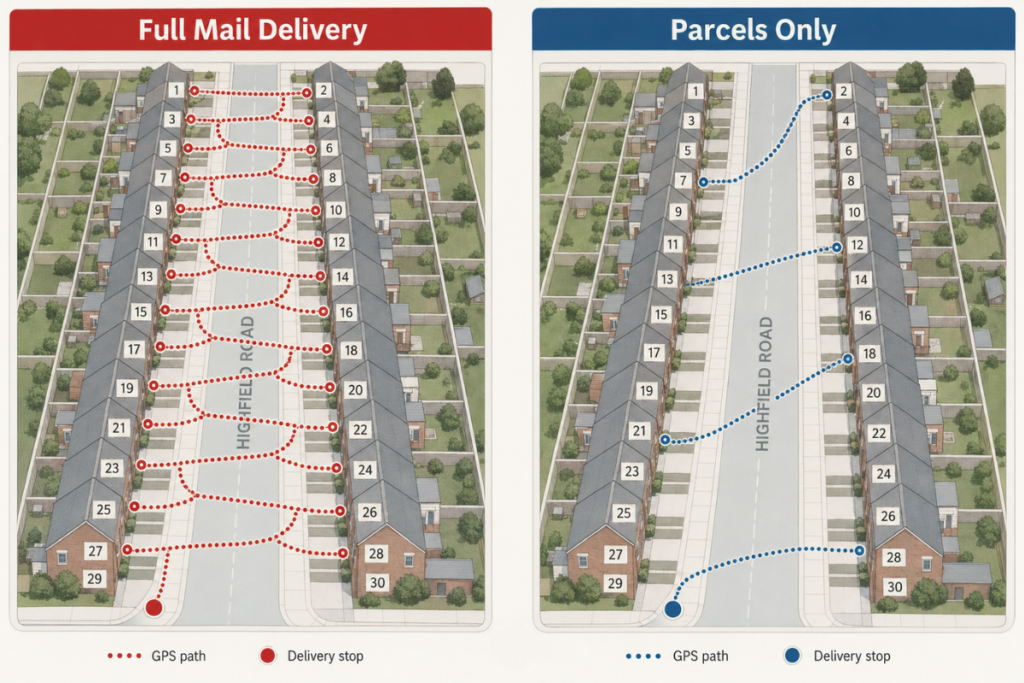
A full letter delivery produces a dense, zig-zagging pattern, walking up almost every path on a street, with micro-stops at nearly every address.
A parcel-only day produces a fractured, scattered trail, jumping from one house to another in a van with twenty addresses skipped in between.
A postie cannot have delivered mail to 100 houses if the GPS only physically visited 8 of them.
2. Outdoor Actuals vs Planned Time
If a loop is modelled to take 3 hours and 20 minutes to deliver in full, and the PDA records it being completed in 55 minutes, there is no interpretation of that data that squares with the mail having gone out.
It is physically impossible to push letters through 400 letterboxes in under an hour.
The only conclusion the numbers support is that the mail did not get delivered.
3. Scan-to-Time Ratios
Every tracked or signed-for item scan is timestamped and geotagged.
If a route shows 45 parcel scans tightly clustered, with almost no un-scanned walking time in between, there is no room in that timeline for standard mail deliveries to have happened.
Letters being pushed through letterboxes leave characteristic gaps in the scan data. If those gaps are not there, the letters were not delivered.
The Legal Tool Is a DSAR, Not an FOI
One important correction for anyone thinking about this.
Royal Mail is a private company, which means it is not subject to Freedom of Information requests. Any FOI sent to Royal Mail will be rejected on that basis alone.
The correct legal mechanism is a Data Subject Access Request, or DSAR, made under the Data Protection Act 2018 and UK GDPR.
Every employee has the absolute legal right to request all personal data their employer holds on them.
PDA data tracks an identifiable individual’s movements, timings and performance, which means it falls squarely within the scope of personal data.
Any posties thinking about doing this should expect Royal Mail to try and argue differently.
Royal Mail has one calendar month to respond.
Requests should be sent to irgt@royalmail.com.
Why It Would Have to Be Coordinated
One postie requesting their PDA data is an administrative inconvenience.
Thousands of posties across the UK requesting their PDA data on the same day is something else entirely.
It forces Royal Mail’s legal and data teams to extract granular GPS telemetry and performance metrics at scale, within a statutory deadline, with no ability to pick and choose which requests to prioritise.
More importantly, once that data is out of the system and in the hands of the workforce, it becomes a permanent, collective record.
Presented in aggregate to investigative journalists, select committees, or Ofcom, it would transition the argument from “disgruntled employees say mail isn’t being delivered” to a dataset the company itself generated, showing exactly when, where, and how often.
Royal Mail can dispute anecdote. It cannot credibly dispute the accuracy of its own PDA evidence, because that is the evidence it uses to hold its own staff to account.
The Tool Cuts Both Ways
For years, the PDA has been used as a stick. Managers have leaned on the data it produces to question performance, challenge timings, and apply pressure on the shop floor.
The same data, collated across the workforce, could be used to answer a different question entirely.
Is the mail being delivered, as Royal Mail has told MPs it is, to more than 90% of UK addresses every day?
The devices that every postie carries already know the answer.
The only thing missing is someone asking them to hand it over.